Hard Boiled Motor Funker
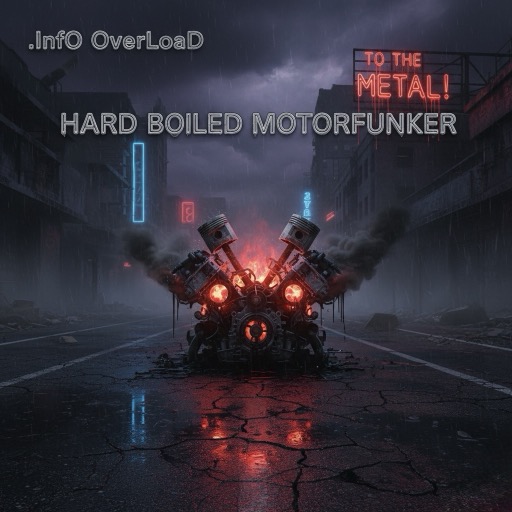








A deliberately crude, garage-rock-inspired homage to adolescent rebellion. Featuring explicit lyrics and intentionally deadpan delivery, the work employs irony as a lens—parodying the performance of “toughness” while revealing an underlying vulnerability.
1. Album Title
Hard Boiled Motor Funker
A title forged in grease, grit, and the metallic sigh of a carburetor coughing its last breath. Not a song—it’s a declaration scrawled on the inside of a rusted garage door. “Hard Boiled” suggests something overcooked, hardened by pressure; “Motor” implies mechanical heartbeat; “Funker” is the grotesque, glorious corruption of rhythm into something raw, unpolished, alive. This album does not groove—it sputters. It is the sound of a teenager revving an engine that won’t start, screaming into the static just to prove he’s still here.
2. Album Direction
A deliberately crude, garage-rock-inspired homage to adolescent rebellion. Featuring explicit lyrics and intentionally deadpan delivery, the work employs irony as a lens—parodying the performance of “toughness” while revealing an underlying vulnerability.
This is not punk. It’s post-punk before it knew its name. The distortion isn’t rebellion—it’s the sound of a broken amp trying to scream truth. The deadpan vocals aren’t apathy—they’re the hollow echo of a boy who learned too early that vulnerability gets you laughed at, so he learned to wear his heart like a cracked fender. Every off-key note is a tear in the fabric of performative masculinity. Every feedback whine, a whispered I’m scared. The crude production isn’t lazy—it’s sacred. It is the sonic equivalent of a handwritten letter smudged by rain and cigarette ash.
3. Band Manifesto (Contextualized)
We believe that music is not merely sound arranged in time, but a living architecture of resonance, presence, and perception. Rooted in first principles, our practice begins not with style, trend, or convention—but with the fundamental truths of acoustics, the physicality of instruments, and the infinite potential of sound generation through synthesis.
In Hard Boiled Motor Funker, these truths are not honored—they are defiled. And in that defilement, they become holy. We do not craft sound with reverence for purity; we wrestle it from the guts of broken amplifiers, from the groan of a loose string, from the hiss of a tape deck that’s seen too many late-night drives with no destination. The manifesto speaks of patience, precision, depth—but here, depth is found in the shallow—in the slurred lyric, the missed chord, the feedback that lingers like a ghost in the room. We do not build instruments; we abuse them until they scream back with honesty. The “alchemy of spatial resonance” becomes the echo in a concrete parking lot at 3 AM. The “subtleties of timbre” are the crack in a voice trying not to cry. Every note is a universe—but this universe is made of cigarette butts, spilled soda, and the metallic tang of adrenaline. We reject haste? Yes—but not because we seek perfection. We reject it because real feeling takes time to ferment in the dark. Expediency is surrender? Here, surrender is the only way to truth. We do not chase novelty—we stumble into it, barefoot and bleeding, through the back alley of adolescence. This is not a style. It’s a wound. And we play it loud.
4. Tracklist
Daym It's Long
The title is a sigh. A yawn stretched into a sentence. “Daym It’s Long” isn’t a complaint—it’s an epitaph for time that refuses to move. In the manifesto, we speak of “the infinite potential of sound generation,” but here, time feels finite, suffocating. The song is a slow, sludgy crawl of power chords and mumbled vocals, as if the guitarist forgot how to play but kept strumming anyway. The “long” isn’t just duration—it’s the weight of expectation, the boredom of being told to grow up while your soul still smells like cheap cologne and burnt rubber. The deadpan delivery isn’t indifference—it’s exhaustion. Each strum is a heartbeat that doesn’t want to keep going. The “long” echoes in the feedback between chords, a sonic void where meaning should be. This is not rebellion against authority—it’s rebellion against the idea that there was ever anything worth rebelling for. The song doesn’t demand attention. It begs to be ignored. And in that silence between the notes, you hear it: the quiet scream of a kid who’s been told to be tough, but doesn’t know how to feel anything without pretending.
Il Passionista
The title is a joke wrapped in Italianate pretense—“the passionate one,” but spoken with the tone of someone rolling their eyes while lighting a cigarette. The song is a three-chord dirge with a saxophone that sounds like it’s been dragged through gravel. The manifesto speaks of “the physicality of instruments,” and here, the saxophone is not an instrument—it’s a broken-down uncle who used to be cool. The lyrics are half-spoken, half-snarled: “I kissed a girl in the rain / she said I was too loud / so I turned up the amp.” This is not passion—it’s performance. The “passionista” is a costume worn by someone who doesn’t know how to love without making it a spectacle. The song’s structure is deliberately clumsy: the drum fill comes too early, the bass drops out for three bars like it gave up. This is the manifesto’s “deliberate iteration” turned inward—each mistake a confession. The passion isn’t real, but the need to be seen as passionate? That’s real. And that’s why it hurts. The song doesn’t climax—it deflates, like a balloon with a hole you didn’t notice until it was too late.
Moja Mala
The phrase means “my little one” in Croatian—a term of endearment twisted into something brittle. The track opens with a single, detuned guitar pluck, then a child’s voice whispering “mama” before it cuts to static. The song is barely two minutes long, and every second feels like a memory dissolving. The manifesto speaks of “sound as a profound act of listening”—here, we are forced to listen to absence. The “Mala” is not a person. It’s the ghost of innocence, the last thing before the world got loud and cruel. The bassline is a slow, uneven heartbeat. The vocals are layered—youthful at first, then gravelly, as if the same voice aged ten years in 90 seconds. There is no chorus. Only repetition: “Moja Mala… Moja Mala…” like a prayer to a god who stopped answering. The “infinite potential of sound” here becomes the infinite loss of meaning. This is not a song about love—it’s a funeral for the idea that love could survive the garage, the schoolyard, the first time someone called you soft. The silence after the final note isn’t empty—it’s full of everything that was never said.
Tungsten
Tungsten is the metal with the highest melting point. It doesn’t bend—it endures. The song is a metallic, industrial stomp: distorted bass drum like a hammer on anvil, guitar strings tuned to the edge of fracture. The lyrics are sparse: “I am not your tool / I am not your toy / I am the thing that won’t break.” The manifesto speaks of instruments as “partners in expression”—here, the instrument is the voice. The guitar doesn’t play notes; it screams. Every note is a fracture in the metal, every feedback loop a scar. This is not rebellion—it’s survival. The “deliberate crude” production isn’t a flaw; it’s the sound of something forged in fire and left to cool in the rain. The title is a declaration: I am not fragile. I am not pretty. I am the thing they tried to break, and it didn’t work. But beneath the noise? A trembling. The last note lingers—not with power, but with exhaustion. Tungsten doesn’t glow. It just… holds. And in that holding, there is grief.
Blunt Baby Blunt
The title is a contradiction wrapped in baby talk. “Blunt” implies violence, clarity, finality. “Baby” implies fragility, dependence, innocence. The song is a three-chord stomp with a vocal track that sounds like it was recorded in a bathroom while someone tried not to cry. “Blunt baby blunt / I don’t know what I’m doing / but I’m doing it loud.” The lyrics are not poetry—they’re graffiti. The guitar is out of tune on purpose. The drums sound like they were hit with a broom. This is the manifesto’s “rejection of expedience” turned inside out: here, expedience is the only truth. The song doesn’t build—it explodes. And then it’s over. No resolution. No catharsis. Just the echo of a kid trying to sound like he’s in control while his hands shake. The “blunt” is the truth he can’t say: I’m scared. The “baby” is the part of him that still wants to be held. This song doesn’t ask for understanding—it demands to be ignored. And that’s why it haunts.
C'mon Now
A command. A plea. A taunt. The song opens with a single, distorted power chord that rings for seven seconds before the drums crash in like a door kicked open. The vocals are shouted, not sung—half-angry, half-laughing. “C’mon now / C’mon now / I know you’re still here.” The manifesto speaks of “presence”—this song is the sound of someone trying to prove they’re still alive. The bassline is a heartbeat that’s skipping. The guitar solo isn’t virtuosic—it’s desperate, three notes repeated until they become a mantra. The “C’mon now” isn’t directed at the listener—it’s directed at himself. He doesn’t believe it. But he says it anyway. The song ends abruptly—not with a crash, but with the sound of a tape running out. No fade. No closure. Just silence after the last syllable. This is not a song about energy—it’s about the fear of running out. The manifesto says: “We create not to be heard—but to be felt.” This song is the sound of someone feeling, and then realizing no one was listening.
Me Land
A phrase that sounds like a child’s declaration. “Me land.” Not my land—me land. As if the world were a toy, and he was the only one who knew how to play with it. The song is a lo-fi, half-tuned acoustic guitar looped over a drum machine that sounds like it’s running on batteries from 1998. The lyrics are fragmented: “I drew a castle / in the dirt / no one came to see.” The manifesto speaks of “spatial resonance”—here, space is not empty. It’s occupied by absence. The guitar rings with the echo of a room no one else has entered. The “me land” is not a place—it’s the last safe space before the world told him to grow up. The song doesn’t build. It circles. Like a kid walking the same path in the backyard, pretending it’s a kingdom. The final note is held too long—until it becomes noise. Until the melody forgets itself. And in that forgetting, we hear what he’s really saying: I made this for me. But I wish someone else had seen it.
Hard Boiled Motor Funker
The title track. The anthem. The wound made audible. It opens with the sound of an engine turning over—three times, then it dies. A single bass note pulses like a pulse. Then the guitar comes in: distorted, out of tune, played with a pick that’s been chewed. The lyrics are shouted like a dare: “I don’t know how to play / but I’m gonna make it loud.” The manifesto speaks of “sound as a profound act of listening”—this song is the sound of someone listening to himself for the first time. The “hard boiled” isn’t toughness—it’s the egg that cracked open and never resealed. The “motor” is the engine of his body, sputtering but still running. The “funker” isn’t a style—it’s the last thing he has left: rhythm, even if it’s broken. The song doesn’t resolve. It stutters. Every time the chorus comes, it’s slightly slower, slightly more broken. The final minute is pure noise—feedback, static, the sound of a tape head wearing out. And then: silence. Not peace. Not triumph. Just the echo of a boy who tried to make something real out of nothing—and almost succeeded.
Crazy S.O.B.
The final track. The last breath. “Crazy S.O.B.”—a phrase spat out with affection, not malice. The song is a single, unbroken 4:17 of feedback, distorted bass, and the sound of someone laughing—then crying. The lyrics are barely audible: “I’m not crazy / I just don’t want to be quiet.” The manifesto says: “We create not to be heard—but to be felt.” This song is the feeling that comes after you’ve screamed until your throat bleeds. The “S.O.B.” isn’t an insult—it’s a badge. A love letter to the kid who was told he was too much, too loud, too strange. The noise isn’t chaos—it’s clarity. Every screech is a truth he couldn’t say in words. The laughter isn’t mockery—it’s release. The final 30 seconds are pure, unmodulated feedback—rising, falling, trembling—and then, just before it vanishes: a single, clear note. Played on an acoustic guitar. Soft. Unamplified. A whisper. The last thing he remembers before the world got too loud to hear himself think.
5. Album as a Living Artifact
Hard Boiled Motor Funker is not an album. It is a ritual object—a shrine built from broken amplifiers, cigarette burns on the dashboard, and the last voicemail a boy never sent. To listen is to kneel in a garage at 2 AM, where the only light comes from a flickering bulb and the glow of a dying phone. This is not entertainment. It is exorcism. Each track is a prayer whispered into the static, each distortion a sacrament of imperfection. The manifesto speaks of “sound as presence”—and here, presence is the only thing left when everything else has been taken: the boy’s trembling hands on the strings, the echo of his voice in a room no one else dares enter.
To hear this album is to be pulled into the hollow space between rebellion and surrender, where the loudest sound is silence. The deadpan delivery isn’t apathy—it’s armor. The crude production isn’t laziness—it’s honesty. Every off-key note is a confession. Every feedback loop, a heartbeat. The album does not ask you to like it. It asks you to remember. To remember the kid who played guitar in his bedroom because he didn’t know how else to say, I’m still here.
When the final note of “Crazy S.O.B.” dissolves into silence, you do not feel relief. You feel seen. Not by the band. But by yourself—by the part of you that still believes in loud, broken things. This album does not change your mind. It changes your breath. You leave the room quieter than when you entered—not because it was silent, but because you finally learned how to listen.
This is not music. It’s the sound of a soul refusing to be erased.