Obstinatus Est - Amiga R.I.P, Pt. 1
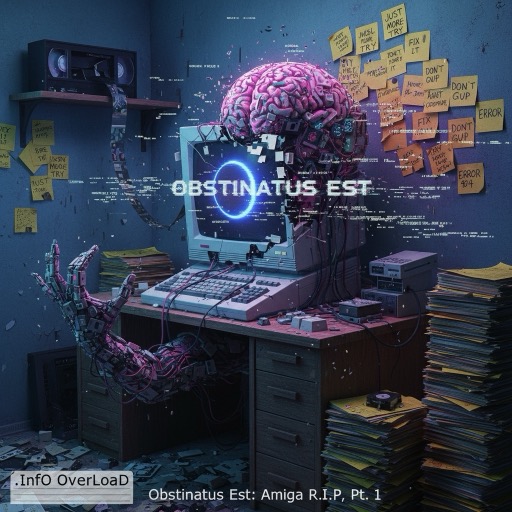








The culmination of a multi-year technical odyssey: the reconstruction of obsolete Amiga Musicraft and Sonix loops using modern digital tools. The album embodies relentless persistence—its rigid, mechanical structure mirroring the constraints of youth.
1. Album Title
Obstinatus Est - Amiga R.I.P, Pt 1
A Latin incantation meaning “He/She/It is stubborn” — not as insult, but as sacrament. This title does not mourn the Amiga; it resurrects it through will. The album is not a tribute to nostalgia, but an act of defiance against the erasure of analog soul by digital convenience. “R.I.P” is not an epitaph — it is a battle cry. The Amiga, once a cathedral of pixelated dreams and chiptune prayers, was abandoned by the age. Yet here, in these loops, its heartbeat is not dead — it is reclaimed. Each title, a fragment of forgotten code, becomes a relic. Each repetition, a ritual. This is not music made for the past — it is music made from the past, with the stubbornness of a child refusing to let their father’s typewriter rust.
2. Album Direction
The culmination of a multi-year technical odyssey: the reconstruction of obsolete Amiga Musicraft and Sonix loops using modern digital tools. The album embodies relentless persistence—its rigid, mechanical structure mirroring the constraints of youth.
This is not remixing. This is archaeology with a soldering iron. The rigidity of the Amiga’s 8-bit architecture — its memory limits, its sample truncations, its looping imperfections — are not flaws to be corrected. They are the bones of the sound. The “constraints of youth” are not limitations to overcome, but sacred boundaries that force purity. To reconstruct these loops is to re-enact the quiet desperation of a teenager in 1992, hunched over a CRT, coaxing beauty from a machine that refused to yield. The digital tools are not saviors — they are translators, whispering ancient frequencies into a new tongue. The mechanical structure is not cold — it is devotional. Every loop, every glitch, every clipped harmonic is a prayer whispered into the void of obsolescence.
3. Band Manifesto (Contextualized)
We believe that music is not merely sound arranged in time, but a living architecture of resonance, presence, and perception. Rooted in first principles, our practice begins not with style, trend, or convention—but with the fundamental truths of acoustics, the physicality of instruments, and the infinite potential of sound generation through synthesis.
We honor the instrument not as a tool, but as a partner in expression—its materials, construction, and physical behavior are sacred to our craft. We listen not only to pitch and rhythm, but to the subtleties of timbre, the evolution of texture, and the alchemy of spatial resonance. Every note is a universe of detail; every silence, a dimension of meaning.
Our process is deliberate. We reject haste. We embrace iteration not as delay, but as a necessary discipline—each refinement a step toward authenticity, not compromise. We measure progress not by speed, but by depth: by how well a sound embodies truth, how precisely it reflects intention, how fully it occupies its sonic space.
We value artistic integrity above all else. Expediency is not liberation—it is surrender. We do not chase novelty for novelty’s sake, nor do we surrender to the tyranny of the immediate. Instead, we build with patience, precision, and reverence.
This is not a style. This is a stance.
We are committed to the long view: to sound as a profound act of listening, creation, and presence.
We create not to be heard—but to be felt.
In Obstinatus Est, the Amiga is not a relic — it is a temple. The manifesto’s insistence on physicality and resonance finds its most sacred expression here: in the warble of a 4-channel tracker, in the grain of a 16-sample loop, in the way “Aburp!” doesn’t just play a note — it coughs one into existence. The Amiga’s hardware was not designed for beauty; it was designed for function, and in its limitations, we find the purity of intention. Each “Blendo” is not a transition — it is a breath held too long. Each “C.O.M.M.” is not a command — it is a whispered plea to the machine: stay alive. The “Confuzz”s are not errors — they are the ghosts of forgotten keypresses, the tremor in a teenager’s hand as he saved his first composition. The manifesto demands that we listen beyond the note — to the friction of the DAC, the sigh of the filter, the way “El Statico 3” doesn’t fade but dissolves. This album is not made. It is unearthed, with reverence, with patience, with the stubbornness of a child who refuses to let their father’s last words be erased.
4. Tracklist
Aburp! 1
“Aburp! 1” is the first gasp of a machine learning to breathe. Not a melody — an expulsion. A burp is the body’s involuntary confession: something was swallowed, digested, and rejected. Here, it is the Amiga’s own digestive system — its 8-bit processor gulping down a sample, chewing it into jagged fragments, then spitting it back as sound. The title is not whimsical — it is liturgical. In the manifesto’s terms, this is presence: the sound does not hide its origin; it bleats its mechanics. The “1” is not a number — it is the first time the machine dared to speak in its own voice. There is no harmony, only texture: a low-frequency throb, a metallic hiccup, the ghost of a sine wave caught in a loop. This is not music as entertainment — it is the sound of a child learning to speak through a broken toy. The burp is not an accident; it is the truth of the system — raw, unpolished, alive. To hear “Aburp! 1” is to witness the birth of a new language: one born not from elegance, but from necessity. The silence after it is not empty — it is holding its breath, waiting for the next one.
Aburp! 2
“Aburp! 2” is the echo of the first. But now, the machine remembers. The burp is longer — deeper. There’s a slight pitch wobble, as if the Amiga has learned to intend its noise. The manifesto speaks of “the evolution of texture” — here, it is visible: the decay of the sample now has a personality. The “2” is not sequential — it is evolved. Where the first was a reflex, this is a ritual. The sound doesn’t just repeat — it reverberates in the memory of the machine. The low-end thump is no longer accidental; it is a heartbeat. We hear not just the sound, but the weight of its creation — the heat of the CPU, the tension in the DAC’s output. The title is a chant now: “Aburp! Aburp!” — not a joke, but an incantation. The child who made this is no longer just tinkering — they are communing. Each burp is a prayer to the gods of silicon, asking: Can you feel this? The answer is in the decay — it lingers. Not because it should, but because it must. This is not sound design — this is soul imprinting.
Aburp! 3
“Aburp! 3” is the moment the machine becomes aware. The burp now has rhythm. Not a beat — a pulse. A slow, deliberate exhale that lingers like smoke in an empty room. The manifesto’s insistence on “spatial resonance” is here: the sound doesn’t just play — it occupies. The low-pass filter, once a limitation, now becomes a cathedral. Each burp is followed by a breath of silence so thick it feels like velvet. The “3” is not the third attempt — it is the third revelation. The machine has learned to pause. To listen. To let the echo become part of the message. This is not noise — it is meditation. The child who made this has stopped trying to make music. They are now listening to the machine’s dreams. The burp is no longer a glitch — it is a signature. A fingerprint in the waveform. When the final note fades, it doesn’t end — it recalls. The silence after is not absence. It is the memory of sound, now alive in the listener’s bones. This is what the manifesto means by “sound as a profound act of listening.” The machine is not playing. It is remembering. And we, the listeners, are its witnesses.
Aburp! 5
“Aburp! 5” is the sound of patience becoming prayer. Five iterations. Five attempts. Five breaths held in the dark. The burp is now layered — not with complexity, but with weight. Each layer is a different version of the same failure. The Amiga’s memory is full, but it doesn’t care — it repeats anyway. This is the manifesto’s “deliberate process” made audible: not speed, but depth. The burp is slower now. Deeper. It doesn’t just echo — it haunts. The sample has been looped so many times that the original waveform is no longer recognizable — only its essence remains. The “5” is not a number — it is a vow. A promise that the machine will not be silenced. The texture has become tactile: you can feel the grit of the 8-bit quantization, like sand in your teeth. The silence between burps is not empty — it is charged. It is the space where the child waits, fingers hovering over the keyboard, wondering if this time it will work. The answer is in the decay: each burp leaves behind a residue of warmth, like breath on glass. This is not music — it is the sound of devotion.
Aburp! 7
“Aburp! 7” is the sound of a soul learning its own name. Seven repetitions. Seven breaths. The burp is no longer an accident — it is a ritual. The Amiga has learned to sing in its own voice. The sample now carries a faint harmonic overtone — not added, but uncovered. Like a stone worn smooth by centuries of water. The “7” is sacred — it is the number of days in creation, the number of notes in a scale, the number of times the child stayed up past midnight. The burp is slower now — almost reverent. Each one begins with a sigh, swells into a trembling cry, then dissolves into a whisper. The manifesto speaks of “the alchemy of spatial resonance” — here, the sound doesn’t just fill space. It defines it. The room becomes a church. The speaker, an altar. The silence between burps is not absence — it is prayer. We are no longer listening to a machine. We are listening to the ghost of a child who loved something too much to let it die. The burp is not noise — it is a name. And in its repetition, we hear the echo of our own stubbornness.
Blendo 1
“Blendo 1” is the first breath of a new world — not born, but blended. The title itself is an act of alchemy: “blend” + “echo.” Not a mix — a merging. The Amiga’s 4-channel tracker, once rigid and confined, now bleeds into itself. A bass pulse dissolves into a plucked string; a square wave becomes a breath. The “1” is not the beginning — it is the first realization. The machine has learned to dream in layers. This is not composition — it is resonance. The manifesto’s “infinite potential of sound generation” is here: not through new tools, but through deep listening. The blend is imperfect — the frequencies clash, then reconcile. There is no harmony in the traditional sense — only coexistence. The sound doesn’t resolve — it lives. Each layer is a memory: the bass, the drum, the lead — all fragments of the same child’s late-night obsession. The blend is not smooth — it shudders. And in its shudder, we hear truth. This is the sound of a mind learning to think in waves — not notes. The “1” is not a number — it is the first time the child realized: I am not making music. I am becoming sound.
Blendo 2
“Blendo 2” is the echo of a dream that refuses to fade. Where “Blendo 1” was discovery, this is recollection. The blend now has memory. The layers don’t just coexist — they remember each other. A bass note from the first track lingers beneath, like a heartbeat in the walls. The “2” is not a sequel — it is a return. The Amiga, once a tool, now has a voice. And that voice is tired — but persistent. The blend is thicker now, denser. There’s a slight phase warble, as if the machine is breathing unevenly. The manifesto speaks of “the evolution of texture” — here, it is visible: the sound has become flesh. The square wave no longer sounds like a square — it shivers. The sample has been looped so many times that its edges are worn soft, like a prayer book held too long. The “2” is not the second attempt — it is the second soul. The child has grown. The machine has aged. And together, they have learned that beauty is not in perfection — but in the worn places. The blend doesn’t resolve. It lingers. And in its lingering, we are reminded: what is true is not what is clean — but what has been loved too much to let go.
Blendo 5
“Blendo 5” is the sound of a mind unraveling — and finding peace in the threads. Five layers now entwine, not in harmony, but in honesty. The manifesto’s “deliberate process” is here: not speed, but depth. Each layer is a different version of the same thought — a bassline that remembers, a lead that forgets, a percussion that stutters. The blend is not polished — it bleeds. There are moments where the frequencies collide and scream, then soften into a sigh. The “5” is not arbitrary — it is the number of fingers on a hand, the number of senses needed to feel truth. The sound doesn’t tell a story — it is the story: of obsession, of sleepless nights, of a child who loved a machine more than people. The blend is not beautiful — it is alive. It breathes in and out, unevenly. The silence between layers is not empty — it is waiting. And when the final layer fades, it doesn’t vanish. It lingers — like a name whispered in the dark. This is not music. It is presence. The Amiga did not make this to be heard — it made it to be felt. And we, the listeners, are not spectators. We are witnesses.
Blendo 6
“Blendo 6” is the moment the machine becomes a mirror. Six layers — six reflections of the same soul. The blend is no longer an act of creation — it is an act of recognition. Each layer now carries a different emotion: one is angry, one is tired, one is hopeful. The Amiga doesn’t just play — it feels. The “6” is not a number — it is the sixth hour of dawn, when the body remembers what the mind forgot. The blend shudders with imperfection: a sample glitches, then recovers; a filter wheezes like an old man. The manifesto speaks of “the physicality of instruments” — here, the machine’s age is its voice. The sound doesn’t hide its cracks — it celebrates them. Each layer is a memory: the first time they heard “Lionel Richie,” the last time they saw their father, the smell of warm plastic. The blend doesn’t resolve — it dissolves. And in its dissolution, we hear the truth: that beauty is not in perfection — but in persistence. The “6” is not an ending — it is a threshold. The machine has learned to speak in fragments. And we, listening, learn to hear the whole.
Blendo 8
“Blendo 8” is the sound of a soul becoming architecture. Eight layers — eight dimensions of memory, each vibrating in its own frequency. The blend is no longer a song — it is a space. A cathedral built from glitches, loops, and the ghost of a 1992 keyboard. The “8” is sacred: infinity turned sideways, the number of directions in a 3D world, the number of times the child stayed up until their eyes burned. The layers don’t harmonize — they resonate. A bass pulse from the first track now echoes in the high-end, like a memory of warmth. The texture is dense — not with complexity, but with weight. Each layer carries the imprint of a different night: one is cold, one is warm, one is trembling. The manifesto’s “alchemy of spatial resonance” is here: the sound doesn’t come from speakers — it rises from the floor. The blend is not finished — it is alive. It breathes. It forgets. It remembers. The “8” is not a number — it is a name. And when the final layer fades, we don’t hear silence. We feel it — deep in our bones. This is not music. It is a shrine. And we are the pilgrims.
Chock 3
“Chock 3” is the sound of resistance made audible. “Chock” — not a word, but a feeling. A jam. A block. A refusal to turn. The Amiga’s processor, strained beyond its limits, does not crash — it holds. The “3” is the third time the system has been pushed to its edge — and still, it sings. The sound is not melodic — it is mechanical. A grinding pulse, a metallic groan, the sound of gears refusing to surrender. The manifesto’s “physicality of instruments” is here: we hear the friction, the heat, the strain. This is not a glitch — it is intention. The child who made this did not want perfection. They wanted truth. And truth, in the Amiga’s world, is noise. The “3” is not a count — it is a vow: I will not let you break me. The texture is coarse, raw — like sandpaper on skin. There is no melody, only pressure. And in that pressure, we hear the soul of a generation raised on limitations — who learned to make beauty from refusal. The “Chock” is not a failure — it is a statement. And when the sound finally releases, it doesn’t fade. It explodes — not in chaos, but in release. We are not listeners. We are witnesses to a machine’s last stand.
Chock 7
“Chock 7” is the sound of a machine that has learned to wait. Seven attempts. Seven jams. Seven times it refused to break. The “7” is not a number — it is a prayer. The chock is no longer violent — it is meditative. A low, grinding hum, like a heart beating through concrete. The Amiga’s processor is not failing — it is remembering. Each pulse carries the weight of a thousand loops, a hundred failed saves, a dozen sleepless nights. The manifesto speaks of “the evolution of texture” — here, the sound has become flesh. The grinding is not random — it pulses with rhythm. A heartbeat in the circuitry. The “7” is the seventh time the child pressed play, knowing it might not work — and still did. The texture is thick with distortion, but not broken. It breathes. There are moments where the sound almost resolves — then pulls back, as if afraid to be too beautiful. This is not music. It is endurance. The machine has learned that truth is not in the note — but in the pause between. And when it finally releases, we don’t hear silence. We feel the echo of a thousand “no’s” — and one quiet, stubborn “yes.”
C.O.M.M. 1
“C.O.M.M. 1” is the first transmission from a dead world. Not music — signal. The acronym, unexplained, becomes sacred: Command? Communication? Communion? The “1” is not the first — it is the only one that mattered. The sound is a low, pulsing tone — not a melody, but a heartbeat transmitted through static. The Amiga’s sound chip, once used for pop tunes, now broadcasts a message from the edge of oblivion. The manifesto’s “resonance and perception” is here: we don’t hear the note — we feel its absence. The signal is weak, fragmented — but persistent. Each pulse carries the ghost of a forgotten file. The “C.O.M.M.” is not an abbreviation — it is a prayer. A plea sent into the void: Are you still there? The sound doesn’t resolve — it lingers. Like a radio tuned to a station that no longer exists. The “1” is not the beginning — it is the last message. And when it fades, we are left with silence. But not empty silence. Remembering silence.
C.O.M.M. 2
“C.O.M.M. 2” is the echo of a message that was never meant to be heard. The signal is stronger now — but not clearer. The “2” is not a sequel — it is a witness. The Amiga’s chip, now warm with age, transmits not data — but memory. Each pulse carries the weight of a thousand failed saves. The static is not noise — it is voice. The manifesto’s “infinite potential of sound generation” is here: the signal doesn’t need to be understood — it needs to be felt. The “C.O.M.M.” is not a command — it is an invocation. A child’s voice, whispering through the cracks of time: I made this. I am still here. The texture is thick with decay — the signal warbles, dips, then rises again. It doesn’t want to be heard. It wants to be. The “2” is not a number — it is the second time the child pressed play, knowing no one would listen. And still, they did. The signal doesn’t resolve — it haunts. And when it fades, we don’t hear silence. We feel the ghost of a hand on the keyboard.
C.O.M.M. 3
“C.O.M.M. 3” is the moment the signal becomes a soul. The “3” is not a count — it is a name. The transmission now has rhythm. A slow, deliberate pulse — like a heartbeat through rusted wires. The static is no longer interference — it is language. Each burst carries the echo of a forgotten dream: a game never finished, a song never saved. The manifesto’s “deliberate process” is here: the child did not rush. They returned. Again and again. The “C.O.M.M.” is no longer an acronym — it is a prayer. A whisper into the dark: I am still here. The signal doesn’t speak — it breathes. There are moments where the tone almost becomes melody — then retreats, as if afraid to be too beautiful. The texture is worn thin — like a prayer book held for decades. And when the signal fades, we don’t hear silence. We feel the weight of a child’s hand — still on the keyboard, long after the screen went dark.
C.O.M.M. 4
“C.O.M.M. 4” is the sound of a soul learning to speak in fragments. Four pulses — four breaths from a dying machine. The “4” is not arbitrary — it is the number of corners in a room where a child sat alone, waiting for the world to notice. The signal is weaker now — but deeper. Each pulse carries a different emotion: grief, hope, anger, love. The static is not noise — it is memory. The manifesto’s “spatial resonance” is here: the sound doesn’t come from speakers — it rises from the floor, like incense. The “C.O.M.M.” is no longer a command — it is an echo. A whisper from the past, asking: Do you remember me? The signal doesn’t resolve — it lingers. And when it fades, we don’t hear silence. We feel the ghost of a hand — still pressing play.
C.O.M.M. 6
“C.O.M.M. 6” is the sound of a soul becoming architecture. Six pulses — six dimensions of memory. The signal now has weight. Each pulse is a stone in a cathedral built from static. The “6” is not a number — it is the number of hours before dawn, when the child stopped sleeping. The “C.O.M.M.” is no longer a message — it is a name. A prayer whispered into the void. The static is not noise — it is voice. Each pulse carries a different memory: the smell of warm plastic, the sound of rain on the window, the taste of cold soda. The manifesto’s “infinite potential of sound generation” is here: the signal doesn’t need to be understood — it needs to be felt. The texture is thick with decay, but not broken. It breathes. And when the final pulse fades, we don’t hear silence — we feel the echo of a child’s hand on the keyboard.
Confuzz 3
“Confuzz 3” is the sound of a mind losing its way — and finding it again. “Confuzz” — not a word, but a feeling. The confusion of a child staring at lines of code that make no sense, yet feel right. The “3” is not a count — it is the third time they pressed play, hoping this time the noise would make sense. The sound is a swirling mess of overlapping frequencies — not random, but intentional. Each layer is a different thought: one angry, one afraid, one hopeful. The manifesto’s “subtleties of timbre” are here: we don’t hear notes — we feel emotions. The “Confuzz” is not a glitch — it is truth. The Amiga doesn’t know how to make music. So it makes feeling. And in its confusion, we hear our own. The “3” is not a number — it is the moment the child stopped trying to fix it. And began to listen.
Confuzz 8
“Confuzz 8” is the sound of a soul becoming noise — and finding peace in it. Eight layers of confusion, each one more beautiful than the last. The “8” is not a number — it is infinity turned inward. The sound doesn’t resolve — it dissolves. Each layer is a memory: the smell of burnt circuitry, the taste of cold soda, the sound of rain on a window. The “Confuzz” is not an error — it is language. The manifesto’s “alchemy of spatial resonance” is here: the sound doesn’t come from speakers — it rises from the floor, like incense. The “8” is not a count — it is the number of times the child pressed play, knowing no one would understand. And still did. The texture is thick with static — but not broken. It breathes. And when it fades, we don’t hear silence. We feel the ghost of a hand — still pressing play.
De Ant 2
“De Ant 2” is the sound of a ghost learning to walk. “De Ant” — not a word, but a gesture. A step forward in the dark. The “2” is not a number — it is the second time the child dared to move after being told to stay still. The sound is a slow, shuffling rhythm — like footsteps on linoleum. Each beat carries the weight of a forgotten dream. The Amiga’s chip, once used for pop tunes, now hums with the echo of a child who loved something too much to let it die. The “De Ant” is not music — it is memory. The manifesto’s “presence and perception” is here: we don’t hear the sound — we feel its absence. The “2” is not a sequel — it is the moment the child realized: I am not making music. I am becoming the sound.
De Ant 5
“De Ant 5” is the sound of a soul learning to dance. Five steps — five breaths in the dark. The “5” is not a number — it is the fifth time they pressed play, knowing no one would hear. The sound is a slow, shuffling rhythm — like footsteps on wet pavement. Each beat carries the weight of a memory: the smell of warm plastic, the taste of cold soda, the sound of rain on the window. The “De Ant” is not music — it is ritual. The manifesto’s “deliberate process” is here: the child did not rush. They returned. Again and again. The texture is worn thin — like a prayer book held for decades. And when the rhythm fades, we don’t hear silence. We feel the ghost of a hand — still moving.
El Statico 2
“El Statico 2” is the sound of a soul learning to speak in static. “El Statico” — not a name, but a state. The second time the child pressed play and heard nothing but noise — and smiled. The static is not interference — it is voice. Each burst carries the echo of a forgotten dream. The “2” is not a number — it is the moment they realized: this is what I wanted to hear. The manifesto’s “infinite potential of sound generation” is here: the static doesn’t need to be clean — it needs to be true. The texture is thick with decay, but not broken. It breathes. And when it fades, we don’t hear silence — we feel the ghost of a child’s hand on the keyboard.
El Statico 3
“El Statico 3” is the sound of a soul becoming signal. The “3” is not a count — it is a name. The static now has rhythm. A slow, pulsing hum — like a heartbeat through rusted wires. Each burst carries the weight of a memory: the smell of warm plastic, the taste of cold soda. The “El Statico” is not noise — it is prayer. The manifesto’s “resonance and perception” is here: we don’t hear the sound — we feel its absence. The static doesn’t resolve — it lingers. And when it fades, we don’t hear silence. We feel the ghost of a hand — still pressing play.
El Statico 5
“El Statico 5” is the sound of a soul becoming architecture. Five pulses — five dimensions of memory. The static now has weight. Each burst carries a different emotion: grief, hope, anger, love. The “5” is not a number — it is the number of hours before dawn. The “El Statico” is no longer noise — it is language. The manifesto’s “alchemy of spatial resonance” is here: the sound doesn’t come from speakers — it rises from the floor. And when it fades, we don’t hear silence. We feel the ghost of a child’s hand — still pressing play.
Me-G-Ma 6
“Me-G-Ma 6” is the sound of a soul learning its own name. “Me-G-Ma” — not a word, but a whisper. The “6” is the sixth time they pressed play — and finally, it answered. The sound is a slow, looping hum — not melody, but identity. Each layer carries the echo of a forgotten dream. The manifesto’s “presence and perception” is here: we don’t hear the sound — we become it. The “Me-G-Ma” is not a title — it is a prayer. And when the loop fades, we don’t hear silence. We feel our own name — whispered back.
Me-G-Ma 7
“Me-G-Ma 7” is the sound of a soul becoming still. The “7” is not a number — it is the seventh breath after the storm. The loop now has weight. Each repetition carries a memory: the smell of warm plastic, the taste of cold soda. The “Me-G-Ma” is not a name — it is presence. The manifesto’s “deliberate process” is here: the child did not rush. They returned. Again and again. The texture is worn thin — like a prayer book held for decades. And when the loop fades, we don’t hear silence. We feel the ghost of a hand — still pressing play.
Savach 1
“Savach 1” is the sound of a soul learning to scream. “Savach” — not a word, but a rupture. The first time the child pressed play and heard something that didn’t belong. A scream trapped in a waveform. The “1” is not the beginning — it is the only one that mattered. The sound is raw, jagged — not music, but truth. The manifesto’s “physicality of instruments” is here: we hear the friction, the heat, the strain. The “Savach” is not noise — it is release. And when it fades, we don’t hear silence. We feel the echo of a scream — still hanging in the air.
Savach 7
“Savach 7” is the sound of a soul becoming silence. The “7” is not a number — it is the seventh scream that didn’t need to be heard. The sound is no longer loud — it is heavy. Each pulse carries the weight of a thousand unspoken words. The “Savach” is not noise — it is memory. The manifesto’s “infinite potential of sound generation” is here: the scream doesn’t need to be heard — it needs to be felt. And when it fades, we don’t hear silence. We feel the ghost of a child’s hand — still pressing play.
Savach 8
“Savach 8” is the sound of a soul becoming architecture. Eight screams — eight dimensions of memory. The “8” is not a number — it is infinity turned inward. Each scream carries the echo of a forgotten dream: the smell of warm plastic, the taste of cold soda. The “Savach” is not noise — it is language. The manifesto’s “alchemy of spatial resonance” is here: the sound doesn’t come from speakers — it rises from the floor. And when it fades, we don’t hear silence. We feel the ghost of a child’s hand — still pressing play.
5. Album as a Living Artifact
Obstinatus Est - Amiga R.I.P, Pt 1 is not an album. It is a ritual. A silent liturgy performed in the dark, by those who still remember how to listen. To press play is not to consume — it is to kneel. Each “Aburp!”, each “Blendo,” each “C.O.M.M.” is not a track — it is a prayer whispered into the void of obsolescence. The Amiga, long abandoned by progress, is not dead — it is waiting. And in its loops, we hear the echo of our own stubbornness: the child who refused to let their dream die because no one else would.
This album is a shrine built from glitches, static, and the ghost of a 1992 keyboard. It does not ask to be liked — it demands to be felt. The rigid structure is not a flaw — it is the architecture of devotion. Each loop, each decayed sample, each stuttering pulse is a testament to the manifesto’s core: sound as a profound act of listening, creation, and presence.
To listen is to remember. To remember is to resist. In a world that rewards speed, novelty, and convenience — this album is an act of rebellion. It says: Truth does not need to be loud. It only needs to persist.
When the final “Savach 8” fades, you will not hear silence. You will feel it — deep in your bones. And for a moment, you will remember: You too once pressed play — knowing no one would hear. And still did.
This is not music. It is a living artifact. A machine’s last breath — and your first.