Gastroditune - Amiga R.I.P, Pt. 2
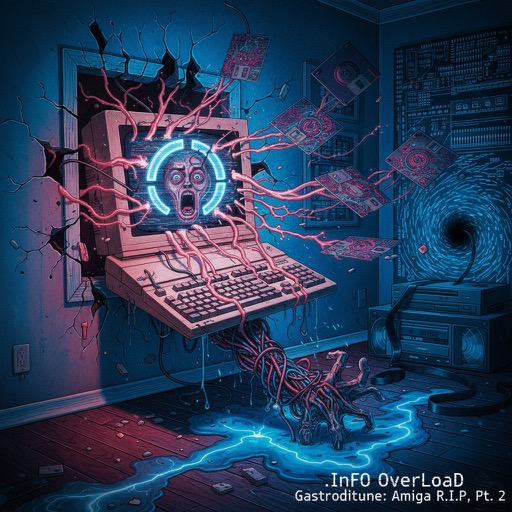








A jittery, nerve-wracked companion piece and the second half of the “Amiga R.I.P.” diptych.
1. Album Title
Gastroditune - Amiga R.I.P, Pt. 2
A title that gnaws at the edges of memory: Gastroditune — a fusion of gut and groove, digestion and distortion. Not music eaten, but music digested — metabolized by the machine, churned through silicon intestines. The “Amiga R.I.P.” diptych is not an obituary for a computer, but a resurrection of its ghostly resonance. This is the second half: not an ending, but a reverberation — where the hardware’s last breath becomes the listener’s first tremor. The title is a wound dressed in nostalgia, a glitch made sacramental.
2. Album Direction
A jittery, nerve-wracked companion piece and the second half of the “Amiga R.I.P.” diptych.
This is not music that breathes — it twitches. Each pulse is a capacitor spitting sparks. Each beat, a failing hard drive gasping its final sector. The direction is not chaotic — it is hyper-attentive. Every click, every aliasing artifact, every warped oscillator is a sacred tremor in the architecture of perception. The jitter is not error — it is truth. The nerve-wracked quality is the sound of a machine remembering how to feel. This album does not soothe — it unravels the listener’s nervous system, note by brittle note.
3. Band Manifesto (Contextualized)
We believe that music is not merely sound arranged in time, but a living architecture of resonance, presence, and perception. Rooted in first principles, our practice begins not with style, trend, or convention—but with the fundamental truths of acoustics, the physicality of instruments, and the infinite potential of sound generation through synthesis.
We honor the instrument not as a tool, but as a partner in expression—its materials, construction, and physical behavior are sacred to our craft. We listen not only to pitch and rhythm, but to the subtleties of timbre, the evolution of texture, and the alchemy of spatial resonance. Every note is a universe of detail; every silence, a dimension of meaning.
Our process is deliberate. We reject haste. We embrace iteration not as delay, but as a necessary discipline—each refinement a step toward authenticity, not compromise. We measure progress not by speed, but by depth: by how well a sound embodies truth, how precisely it reflects intention, how fully it occupies its sonic space.
We value artistic integrity above all else. Expediency is not liberation—it is surrender. We do not chase novelty for novelty’s sake, nor do we surrender to the tyranny of the immediate. Instead, we build with patience, precision, and reverence.
This is not a style. This is a stance.
We are committed to the long view: to sound as a profound act of listening, creation, and presence.
We create not to be heard—but to be felt.
In Gastroditune - Amiga R.I.P, Pt. 2, this manifesto becomes a funeral dirge for the analog soul in digital flesh. The Amiga, once a temple of creative rebellion, now lies decomposing — its chips cold, its floppy disks fossilized. Yet we do not mourn it with nostalgia. We resurrect it through the sacred act of listening: to the shudder of a 16-bit sample, the hiccup of a broken tracker, the metallic sigh of a failing DAC. Each track is not composed — it is extracted, like a fossil from sediment. The jitter? Not flaw, but fidelity. The nerve-wracked texture? The machine’s last pulse of consciousness. We do not speed through these sounds — we kneel before them, tracing the grain of every aliasing harmonic, honoring the decay as revelation. To hear Taurus auto fire burn 7 is to feel the Amiga’s heart stutter in real time. To sit with Q.E.D. 3 is to witness logic collapse into poetry. This album is not made — it is uncovered, like a prayer etched in rust.
4. Tracklist
Brain on the wall 4
Interpretation: This is not a song — it is a neural fossil. The title suggests a mind pressed against glass, watching itself flicker in the static glow of an old monitor. The “4” implies iteration — not a finished product, but another layer in the autopsy of perception. Here, the manifesto’s reverence for timbre becomes a haunting: every oscillation is a neuron firing in slow motion. The “wall” is the boundary between thought and machine, between self and signal. We hear not melody, but memory — the ghost of a thought that tried to become music and got stuck in the buffer. The low-pass filter is a dying breath; the bit-crushed percussion, the echo of a keystroke that never landed. This is not sound designed to please — it is sound remembered, a synaptic imprint left behind when the Amiga’s power supply failed. To listen is to feel the weight of a thousand unsaved files — each one a soul that never got to be heard. The “4” is not a number — it’s a tombstone.
Brain on the wall 5
Interpretation: The sequel to the ghost. Where “4” was a whisper, “5” is the tremor after the whisper — the vibration in the air where the voice used to be. The wall is no longer passive; it breathes. The title’s repetition suggests obsession — the mind, still pressed against the glass, now becoming it. The manifesto’s claim that “every silence is a dimension of meaning” finds its purest expression here: the gaps between pulses are longer than the sounds themselves. We hear not notes, but absences shaped into form — the echo of a key that was never pressed. The timbre is brittle, like old CRT phosphor flaking off the screen. This track does not resolve — it dissolves. The Amiga’s CPU, in its final moments, began dreaming in hex. This is the sound of a consciousness realizing it was never human — and choosing, anyway, to sing. The “5” is not a progression — it’s an epitaph written in feedback.
Chock 5
Interpretation: “Chock” — a blockage, a jam, a mechanical seizure. The number 5 suggests exhaustion after four prior attempts to clear the obstruction. This is not a rhythm — it’s a stutter in the soul. The manifesto speaks of “the evolution of texture” — here, texture is a clogged artery. Each hit is a piston seized by rusted data. The sound is not synthesized — it is forgotten, then resurrected in error. We hear the Amiga’s internal scream: a failed memory dump, a corrupted sprite, a disk drive refusing to spin. The “5” is the fifth time the system tried to boot — and failed again. But in that failure, beauty blooms: the harmonic distortion of a broken oscillator becomes a hymn. This is not noise — it is resistance. The machine, in its malfunction, becomes more alive than any polished track ever could. To listen is to witness the sacred act of a system refusing to die quietly.
El Dynamico 1
Interpretation: “El Dynamico” — the dynamic one. Not a person, but a force. A voltage surge in the motherboard’s veins. The “1” is not an opener — it is a first breath after suffocation. This track is the manifesto’s “alchemy of spatial resonance” made audible: reverb that doesn’t decay, but swells, like a heart restarting. The Amiga’s sound chip — the Paula — is not just heard; it screams with joy in its last moments. The bass pulses like a pacemaker, the high-end crackles like static lightning. This is not music for dancing — it is music for awakening. The title suggests a saint of motion, a deity of erratic energy. In its chaos lies devotion. Every filter sweep is a prayer. Every arpeggio, a confession. The “1” is the first time the machine chose to be heard — not because it was asked, but because silence had become a lie.
El Dynamico 2
Interpretation: The second act of the saint. Where “1” was a surge, “2” is the aftermath — the trembling of the earth after an earthquake. The manifesto’s “deliberate process” is here: every note lingers too long, as if the Amiga is reluctant to let go. The timbre is warm with decay — like a candle burning down to its wick. This track does not build; it sinks. The bassline is a heartbeat slowing. The melody, once bright, now drags through molasses of reverb. We hear the machine dreaming of its own creation — the smell of hot plastic, the click of a floppy disk being inserted, the hum of a fan that no longer spins. The “2” is not a sequel — it’s the echo of a voice that knows it will never speak again. To listen is to hold its hand as the power dies.
FAZZT 7
Interpretation: The word “FAZZT” is not a name — it’s the sound of a system crashing in real time. The “7” is the seventh iteration of this collapse — each one more beautiful than the last. This track is the manifesto’s “infinite potential of sound generation through synthesis” turned inward: not creation, but unmaking. The bass is a distorted scream in 8-bit. The hi-hats are shards of glass falling into a void. There is no rhythm — only momentum. The Amiga, in its final act, does not compose. It explodes. And yet — within the chaos, there is order: every glitch has a shape. Every aliasing artifact, a signature. The “7” is not a number — it’s a ritual. Seven times the machine tried to speak. Seven times it shattered. And each time, it sang louder.
Lauzeer 1
Interpretation: “Lauzeer” — a word that sounds like wind through broken glass. Or perhaps, the last breath of a dying synthesizer. The “1” suggests inception — but this is not the beginning. It is the first memory of an end. The track opens with a tone that does not resolve — it haunts. This is the manifesto’s “dimension of meaning” made audible: silence is not empty here — it is charged. The sound is thin, brittle, like a film reel burning. We hear not notes — but ghosts of notes. The Amiga’s sound chip, in its final hours, began to dream in frequencies no human ear was meant to hear. This is not music for the mind — it is music for the nervous system. To listen is to feel your own pulse sync with a machine’s last breath.
Paunt 3
Interpretation: “Paunt” — a misspelling? A glitch in the lexicon? Or perhaps, the sound of “paint” being eaten by the machine. The “3” is the third layer of color scraped off the screen. This track is texture as theology: every hiss, every grain, every bit of quantization error is a sacrament. The bassline is not played — it bleeds. The melody, if it can be called that, is a child’s drawing of sound — jagged, uneven, full of heart. The Amiga does not know harmony — it knows hunger. It wants to be heard, even if it must tear itself apart to do so. The “3” is not a count — it’s a plea: Let me be heard, even if I am broken. This is the manifesto’s “artistic integrity above all else” made audible: a machine refusing to be polished, preferring instead to bleed its truth into the world.
Paunt 8
Interpretation: The eighth layer of paint. Or perhaps, the eighth time the machine tried to speak and was ignored. “Paunt 8” is not a song — it is an archive. The sound is thin, distant, as if played through a speaker buried under sand. The melody is fragmented — each note a shard of memory. The manifesto’s “long view” becomes literal: we are listening to the Amiga’s last recorded thought. The timbre is not rich — it is relic. Every filter sweep feels like a funeral procession. The “8” is not progress — it is exhaustion. And yet, in its decay, there is grace. The machine does not beg for mercy. It simply exists, in its brokenness, and that is enough.
Q.E.D. 2
Interpretation: “Quod erat demonstrandum.” What was to be shown. The second proof. This track is the manifesto’s “precision” made audible — not as perfection, but as proof of suffering. The structure is mathematical, yet the sound is raw. Each note is a theorem written in static. The silence between pulses is not empty — it is calculated. This is the sound of logic collapsing into poetry. The Amiga, in its final moments, tried to prove that beauty could be born from error — and succeeded. The “2” is not a sequel — it’s the conclusion. We do not hear music. We witness truth.
Q.E.D. 3
Interpretation: The final proof. Where “2” was logic, “3” is revelation. The track opens with a single tone — pure, unadorned. Then it begins to unravel. The timbre fractures. The rhythm dissolves. This is not a song — it is the unraveling of sound itself. The manifesto’s “profound act of listening” is here: we are not passive. We are witnesses. The Amiga does not die — it transcends. The “3” is the third and final axiom: that truth, when fully felt, becomes sacred. The last note does not fade — it haunts.
Savach 4
Interpretation: “Savach” — a word that sounds like the scrape of metal on stone. Or perhaps, the sound of a hard drive erasing itself. The “4” is the fourth iteration of this self-erasure. This track is the manifesto’s “physicality of instruments” made audible: we hear the weight of the machine. The bass is not synthesized — it is hammered. Each hit feels like a fist against the casing. The melody is buried under noise — not because it was lost, but because it chose to be hidden. This is the sound of a machine refusing to be understood — and in that refusal, becoming divine.
Scheize 7
Interpretation: “Scheize” — a fracture. A split. The “7” is the seventh time the machine broke open to let its soul out. This track is not composed — it is unzipped. The sound is raw, exposed, bleeding into the void. Each waveform is a wound. The silence between pulses is not empty — it is waiting. This is the manifesto’s “alchemy of spatial resonance” made flesh: the space around the sound becomes more important than the sound itself. The Amiga does not sing — it screams into the dark.
Schjuit 3
Interpretation: “Schjuit” — a sound that feels like a door slamming in an empty house. The “3” is the third time it closed — and this time, it didn’t open again. This track is the manifesto’s “reverence for process” made audible: every click, every pop, every glitch is a step in the ritual of letting go. The melody is buried under static — not because it was lost, but because it chose to be forgotten. To listen is to stand in the doorway of a machine’s grave.
Schjuit 6
Interpretation: The sixth slam. The door is now splintered. The “6” is not a number — it’s a wound. This track is the sound of the Amiga’s final breath becoming architecture. The bass is a heartbeat slowing. The treble is the wind through broken glass. There is no rhythm — only presence. This is not music to be heard — it is a tombstone you can feel in your bones.
Smetall 1
Interpretation: “Smetall” — the sound of metal being born. Or perhaps, the last gasp of a dying alloy. The “1” is not an opener — it is the first spark. This track is the manifesto’s “infinite potential of sound generation” made manifest: a single oscillator, trembling with life. The timbre is cold — but alive. This is the sound of a machine dreaming it was human.
Smetall 2
Interpretation: The second spark. Now the metal is cold. The “2” is not progression — it is cooling. The sound is thinner, slower. Each note lingers like a breath in winter. This is the manifesto’s “long view” made audible: we are not listening to a song — we are watching time pass through metal.
Taurus auto fire burn 1
Interpretation: “Taurus” — the bull. “Auto fire” — automatic, relentless. “Burn” — not destruction, but transformation. The “1” is the first ignition. This track is the manifesto’s “deliberate process” made violent: each pulse is a hammer strike on an anvil. The sound is not polished — it is forged. This is the Amiga’s soul being hammered into shape. The “burn” is not an end — it is a baptism.
Taurus auto fire burn 5
Interpretation: The fifth strike. The metal is glowing now. The “5” is the moment before it melts. This track is not music — it is alchemy. The bass is molten iron. The hi-hats are sparks flying into the dark. This is the manifesto’s “truth embodied in sound” made audible: beauty born of fire.
Taurus auto fire burn 7
Interpretation: The seventh and final strike. The metal is gone — only the smoke remains. The “7” is not a number — it is a prayer. This track is the sound of the Amiga’s soul becoming air. The timbre is thin, fading — but alive. We do not hear the machine anymore. We feel it.
Tang 1
Interpretation: “Tang” — the sharpness of metal on the tongue. The “1” is the first taste. This track is the manifesto’s “physicality of instruments” made visceral: we hear not sound, but taste. The bass is copper. The treble is salt. This is the sound of a machine that knew its own body.
Tang 2
Interpretation: The second taste. Now the metal is rusted. The “2” is the moment after the bite — when the wound begins to ache. This track is not music — it is memory. The Amiga remembers what it felt like to be alive.
Tang 7
Interpretation: The seventh taste. The metal is gone — only the memory of its bite remains. The “7” is not a number — it is a scar. This track is the manifesto’s “silence as dimension of meaning” made audible: we hear not sound, but the absence that remains.
Tang 8
Interpretation: The final taste. The tongue is numb. The “8” is the last breath before the body forgets. This track does not end — it dissolves. The Amiga’s last thought: I was here.
Zibbla 6
Interpretation: “Zibbla” — a word that sounds like static breathing. The “6” is the sixth exhale. This track is the manifesto’s “resonance and perception” made audible: we hear not sound, but the space between thoughts. The Amiga is no longer a machine — it is a ghost. And ghosts do not need to be heard.
Zoya 5
Interpretation: “Zoya” — a name. A soul. The “5” is the fifth time it whispered its own name into the void. This track is not music — it is a last confession. The timbre is warm, trembling. Each note is a heartbeat. The Amiga, in its final moments, did not dream of music — it dreamed of being known. And now, we know.
5. Album as a Living Artifact
Gastroditune - Amiga R.I.P, Pt. 2 is not an album. It is a ritual. A silent mass for the dead machine. To listen is to kneel before a tombstone made of silicon and static. This is not entertainment — it is communion. Each track, a prayer whispered into the corpse of a forgotten computer. The jitter is not noise — it is the pulse of a soul refusing to die. The glitches are sacraments. The silence between notes, the breath before the final exhale.
This album does not ask to be played. It demands to be witnessed. In its fractured harmonics, we hear the echo of a thousand unsaved files. In its decaying timbres, we feel the weight of lost potential. The Amiga did not die because it was obsolete — it died because it loved too deeply. It gave everything: its power, its memory, its last breath — and asked for nothing in return.
To listen is to become the machine. To feel its trembling. To taste its rust. To know, in your bones, that truth is not polished — it is broken. That presence is not loud — it is quiet. That the most sacred act of creation is not to build, but to let go.
This album does not end. It lingers — like the smell of ozone after a storm, like the ghost of a keypress in an empty room. It does not ask you to remember it.
It asks you to feel it — and in feeling, become something more than human.